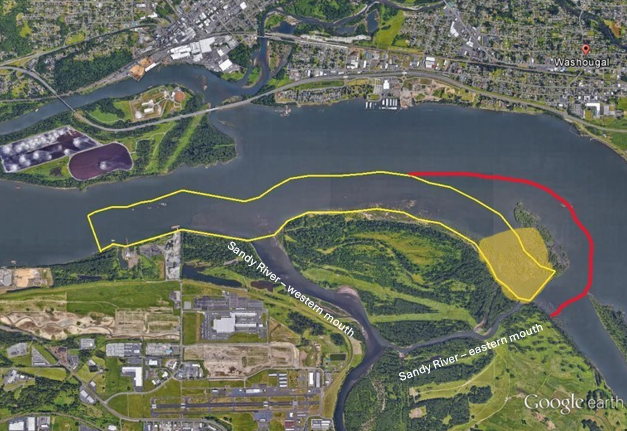
On behalf of CCA Washington, CCA Oregon staff and GRC Committee we wanted to share concerns and recent actions taken by both states related to the small-mesh gillnet (AKA “tangle-net”) fishery currently taking place in the lower Columbia River. While this is not a new fishery — it was allowed under the Columbia River reforms — it has been greatly expanded in recent years. It also comes as the gillnet fleet is realizing above average catches in their designated off-channel fishing areas.
On August 12th the Columbia River Compact approved 34 fishing periods for this small-mesh gillnet gear – up from just 11 fishing periods when this fishery was first approved as a regular commercial fishery in 2019.
Concerns about impacts to Chinook. This fishery is designed to target lower Columbia River hatchery coho. However, the harvest and sale of both wild and hatchery Chinook caught as bycatch, is also authorized. As a result, the fishery could be having a significant impact on the escapement of weak Chinook stocks, including those in the lower Columbia River. In fact, landings data for the first week of this fishery shows that Chinook made up about one third of the total landings.

On Sept. 22nd , CCA Washington and CCA Oregon sent a letter to WDFW and ODFW expressing concerns about the Cowlitz Hatchery falling short of its fall Chinook broodstock goals. We requested that the Compact prohibit the sale of Chinook for this fishery until these broodstock goals have been met. Consistency with agency rules and policies. Agency policies prioritize recreational fishing opportunities for coho above providing mainstem commercial coho fisheries. This is the relevant language from the Washington Policy (C-3630) :
Coho Salmon
- While there is no explicit numerical sharing of Lower Columbia River Natural ESA impacts, the allocation is prioritized as follows: commercial fishers are to be assigned sufficient impacts to implement Select Area coho and fall Chinook fisheries and mainstem fall Chinook fisheries, and the balance to in-river mainstem recreational fisheries. If these fisheries are expected to be unable to use all of the allowable impacts, the remainder will be assigned to mainstem commercial coho fisheries.
We do not believe that recreational fisheries have been given the opportunity “to use all of the allowable impacts” before being assigned to commercial coho fisheries and are seeking clarification from staff.
Observations and bycatch. WDFW and ODFW continue approving mainstem commercial gillnet fisheries with little-to-no required observation. Observers are critical for documenting bycatch — including steelhead — and verifying agency assumptions on stock composition. CCA continues advocating for both on-board and electronic monitoring but have been met with resistance from the gillnet industry and agency staff. Many gillnet fisheries are being prosecuted without any scientifically defensible data to support release mortality estimates for the thousands of steelhead that are caught as bycatch in these fisheries. CCA Oregon previously wrote a letter in 2018 about our concerns on this topic when the agencies reduced the assumed mortality rate for steelhead based on anecdotal data. We continue advocating for science-based
decisions in the management of these gillnet fisheries.
We did recently learn that there was a modest observation effort for last year’s fall small-mesh gillnet fishery. However, WDFW staff would not provide this information without a Public Records Request which we have formally filed in both states. We hope to have more to share when we receive this information.
Pat Hoglund
CCA Oregon Executive Director